

Press Release issued by Space Biospheres Ventures in September 1993
Oracle, AZ—On March 6, 1994, seven researchers—five men and two
women—were sealed inside the closed ecological system and research facility
in the Santa Catalina Mountain foothills north of Tucson.
The crew works under a new scheduling policy that allows scientists and other visitors to enter for short stays to conduct research while the six members of the resident operational crew has staggered stays in the structure for at least 180 days.
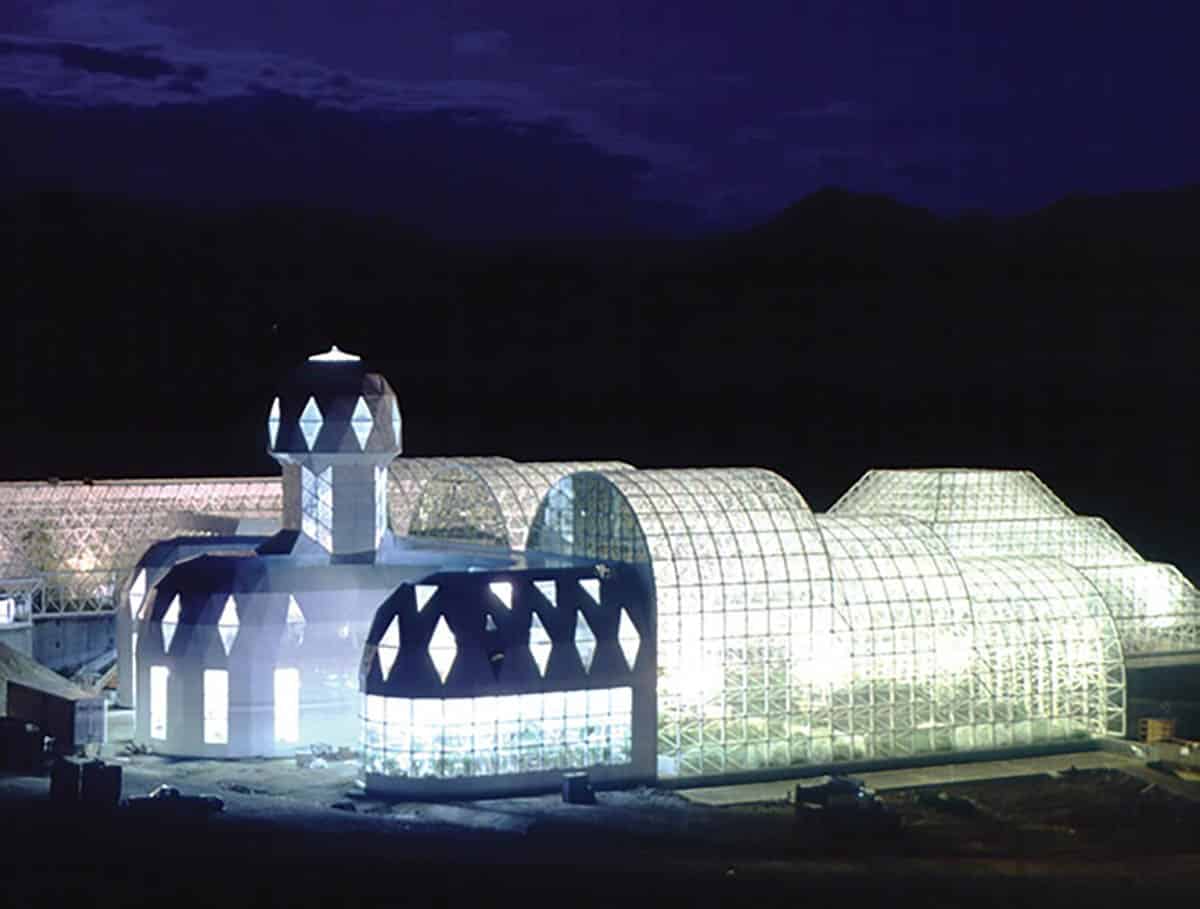
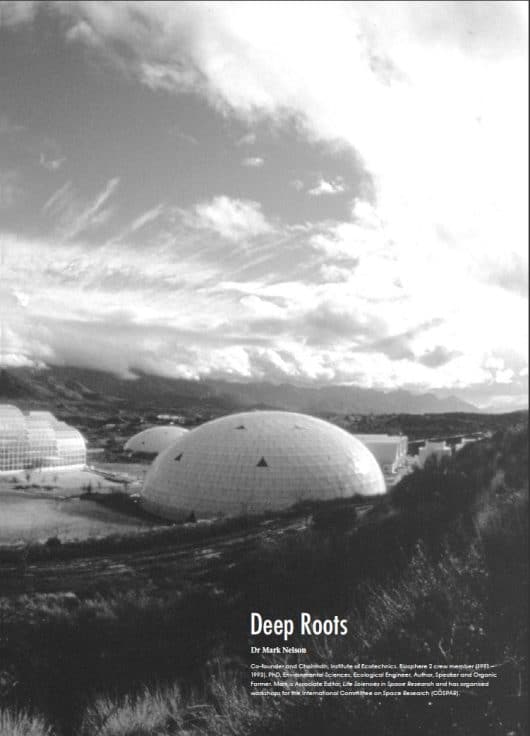
Biosphere 2 is an unprecedented, on-going ecological experiment, built as a laboratory for global ecology. It is a tightly sealed glass and steel structure on 3.15 acres near Oracle, Arizona in which scientists have created seven complete ecosystems or biomes that mirror those of Earth. The systems include an ocean, a desert, a savannah, a rainforest, a marsh, an area of intensive agriculture, and a human habitat. The project is designed to last a century, providing valuable data for research and education to help scientists better understand how our world works.
On September 26, 1991, eight researchers, known as “biospherians,” sealed the airlock on this massive enclosed ecological system—and Biosphere 2 began. Following their two-year stay, the men and women emerged from their mini-world on September 26, 1993. A transition period of approximately five months included intensive data collection, plant and animal inventories, new research projects and mechanical modifications to systems within Biosphere 2. The current mission is one of a series of missions to take place throughout the projected 100 years of the experiment.
Space Biospheres Ventures Space Biospheres Ventures (SBV) is a private ecological research firm formed to pioneer research in the field of biospherics, the study and construction of closed, self-regulating, self-sustaining, ecological systems. SBV was founded in 1984 by Edward P. Bass, Margret Augustine, John Allen, and Mark Nelson.
SBV designed, built and operates Biosphere 2, the world’s largest and most complex closed ecological research facility. The project was organized as a private, venture capital endeavor to promote research and develop inventions and techniques with a wide range of applications from environmental engineering and clean-up to agriculture and life-support systems.
The Biosphere 2 Project The project is designed for three purposes: research, education, and the development of environmental technologies for use on Earth and in outer space. Biosphere 2 is a new type of laboratory which combines state-of-the-art architecture and mechanical and computer monitoring systems with a wide range of living ecosystems. It is an experimental project where everything that happens—both expected and unexpected—provides valuable insights into our complex and evolving world.
While the biospherians further the research of more than 60 projects,
42 Ph.D.- level scientists are formally analyzing the information gathered
inside Biosphere 2, as they study such topics as carbon dioxide and oxygen
cycles, soil composition, coral reef health and vitality, agricultural
pest management, waste and water recycling, and more. Every two weeks,
the biospherians send the samples they have collected through the airlock
to scientific consultants and analytic laboratories for study.
Publication in peer-reviewed journals of findings from Biosphere 2
research include: Proceedings of the National Academy of Sciences (December,
1992) - a human nutrition study by physician Dr. Roy Walford; Bioscience
(April, 1993) - “Using a Closed Ecological System Earth’s Biosphere” by
Mark Nelson, Tony Burgess, Abigail Alling and others. Other papers include
Biosphere 2 Agriculture: Test bed for intensive, sustainable, non-polluting
farming systems by Mark Nelson, Sally Silverstone and Jane Poynter, and
Maintenance and Operational Support Characteristics of Biosphere 2 by William
F. Dempster and Mark Van Thillo. Numerous other scientific papers are in
review or being prepared for submission.
Biosphere 2 received the top Special Award in the 1992 Gold Nugget
Awards competition sponsored by the Pacific Coast Builders Conference and
Sun/Coast Architect/Builder Magazine. The Gold Nugget Awards are considered
the most prestigious design awards in the nation.
In 1994, Biosphere 2 received a Grand Award in the Awards of Excellence
competition, presented by the National Association of Home Builders National
Commercial Builders Council. These awards are considered among the most
prestigious in the nation by the building industry. The project was entered
in tile industrial category for buildings over 50,000 square feet.
In addition to engineering excellence, the architecture of Biosphere
2 exhibits what architect Phil Hawes and designer Margret Augustine term
“synergetic” architecture, with various sections exhibiting diverse cultural
references from Maya pyramids to Middle Eastern wind towers to create a
complete and harmonious design.
Structure The Biosphere 2 structure covers
approximately 3.15 acres (1.28 hectares), the size of three football fields;
its volume is seven million cubic feet (204,000 cubic meters) and stretches
up to 91 feet at its highest point (23 meters high). Its glass-and-steel
superstructure is designed to be leak-free, and its substructure is lined
with up to four inches of stainless steel which was welded and tested for
air tightness. Its steel struts are covered with a finish that insures
against corrosion from inside or outside the biosphere. All air, water
and nutrient cycles are completely closed and recycled within this system.
The monitoring of climate, air, soils and water within Biosphere 2
is unprecedented. Over 1,000 sensors distributed throughout the Biosphere
send information to the sophisticated monitoring and control system located
on-site at Mission Control. This elaborate computer network provides a
continuous display of environmental variables and the status of engineering
controls—while constantly updating the permanent data base.
The different zones of Biosphere 2 include agriculture, a human habitat,
an ocean, a tropical rainforest, a Savannah, a marsh, and a desert. Each
biome was built with carefully selected soils, water and plant and animal
life, collected from all over the world. Biosphere 2 sustains high biodiversity
with several thousand species living within its glass walls.
Human Biomes The human habitat is a six-story,
white domed section of Biosphere 2 that includes apartments for resident
researchers, laboratories, a computer center, communications and office
space, workshops and a library. This portion of Biosphere 2 was designed
to take on the ecological challenges of our cities. Domestic animals (African
pygmy goats and hybrid fowl) are kept in a section of the human habitat.
Next to the animal bay and immediately south of the human habitat, a series
of arched spaceframe vaults houses the intensive agriculture biome. Here,
food crops are grown on broad terraces in 24,000 square feet of space (.55
acre or .22 hectare).
During the transition period following the first closure, new supplemental
lighting was installed in this area to help compensate for any extended
cloud cover during the next 10 1/2-months. New food crops were also introduced.
The Wilderness Biomes The tropical rainforest
biome occupies the tallest (approximately 91 feet or 23 meters high)
section of Biosphere 2’s spaceframe structure. A stream cascades down the
mountain in the rainforest’s center, through a flood plain on the forest
floor and into Biosphere 2’s tropical savannah biome (atop rock
cliffs beside the ocean). From there the stream travels down to the marsh
biome, both fresh and salt water, and then into the Biosphere 2 ocean
biome. The ocean is 25 feet (8 meters) at its deepest and includes
a Caribbean coral reef ecosystem at the northern end. Wave action, required
for the coral reef ecology, is generated mechanically. At the southern
end of Biosphere 2’s central section, a thornscrub forest completes the
savannah biome and marks the ecotone (transition zone) between the savannah
and coastal thornscrub desert biomes. During transition, all of these biomes
were inventoried to determine species success and failure. Some modifications,
such as planting additional food crops in the rainforest, and adding trees
to the coastal desert biome occurred during this time.
The Biosphere 2 Lung West and South
of Biosphere 2 are two white geodesic dome structures, called “lungs” connected
by underground tunnels to the Biosphere 2 basement. The lungs are variable
volume chambers able to expand and contract with shifts in atmospheric
volume/pressure. Otherwise, the warming and expansion of air during the
day could blow out glass panes or break the seals on Biosphere 2. The lungs’
total volume capacity is 1.7 million cubic feet (50,000 cubic meters).
Biosphere 2 Atmosphere and Water Recycling The
air is continuous throughout Biosphere 2. Air circulates among the wilderness
biomes, human habitat and lungs.
“The achievements of the biospherians go beyond the application
of state-of-the-art methods of sustainable agriculture. Biosphere 2 recreates
in miniature the flows and balances that occur on Earth - but it moves
through these cycles on ‘fast forward.’ Carbon dioxide turnover on Earth
takes about three years: in Biosphere 2 it takes about three days. On Earth
it takes years or decades to see how changes in the rainforest affect the
growth of sorghum or sweet potatoes in another part of the world; in Biosphere
2, the impact may be seen in a matter of weeks. In Biosphere 2, agricultural
materials such as crop nutrients and animal wastes recycle through the
water and air systems in days, as opposed to weeks or years on Earth. It
is, in this sense, an ecological laboratory of incalculable value—the world’s
largest test-tube.”
Dr. Richard Harwood, C.S. Mott Foundation Chair of Sustainable
Agriculture Department of Crop & Soil Sciences at Michigan Stale University
Biosphere 2 is not large enough for weather processes to occur entirely
naturally, as they do on Earth. Mechanical systems assist the heating,
cooling, and air and water circulation. Water evaporation from the ocean
is condensed for human drinking water and for return to the stream and
rainforest. Human and animal wastes are treated in a combination microbial
and intensive wetlands ecosystem. Water effluent is tested before returning
to the irrigation system.
Biospherians The biospherians are selected as resourceful individuals with research and survival skills. They are the project's front-line researchers and operators who work on a daily basis with the Mission Control team, scientific consultants, and with Director of Research, Dr. John B. Corliss.
Each Biospherian is assigned specific responsibilities inside the biosphere, such as managing and conducting research within separate biomes, coordinating the biosphere's technical system, as well as planting and harvesting crops. The five men and two women who are members of the crew inside Biosphere 2 hail from the United Slates, Germany, Mexico, England, Australia, and Nepal. Their diverse backgrounds range from environmental biology, horticulture, forestry, and gardening to chemical engineering, and maintenance.
Points of Interest Significant accomplishments
have marked the experiment, including: